
A New Era of EIGEN Incentives

A proposed new Incentives Committee would direct programmatic emissions with a focus on growing the EigenCloud ecosystem and fee revenue, improving allocation efficiency, and driving value back to EIGEN.
As part of a broader interrogation of EIGEN tokenomics by Eigen Labs and the Eigen Foundation, the recently introduced ELIP-12 proposes an Incentives Committee, a new governance body to better manage and direct token emissions approved by the Protocol Council. Staffed by the Eigen Foundation and Eigen Labs, the Incentives Committee would be tasked with setting policy for allocating token emissions to participants actually securing the AVSs, building on EigenCloud, and generating real fees. The Incentives Committee will also establish mechanisms to use EigenLayer and EigenCloud fees to benefit EIGEN token holders. If you're actively staking or building on EigenLayer or holding EIGEN, here's what this means for you.
What's Changing?
ELIP-12 proposes a new Incentives Committee that will direct EIGEN token emissions according to a new incentives policy set by the Protocol Committee. The current governance discussion is happening now on the Forum. This shift would bring three core improvements if implemented:
1. Introducing a fee model for EigenLayer and EigenCloud
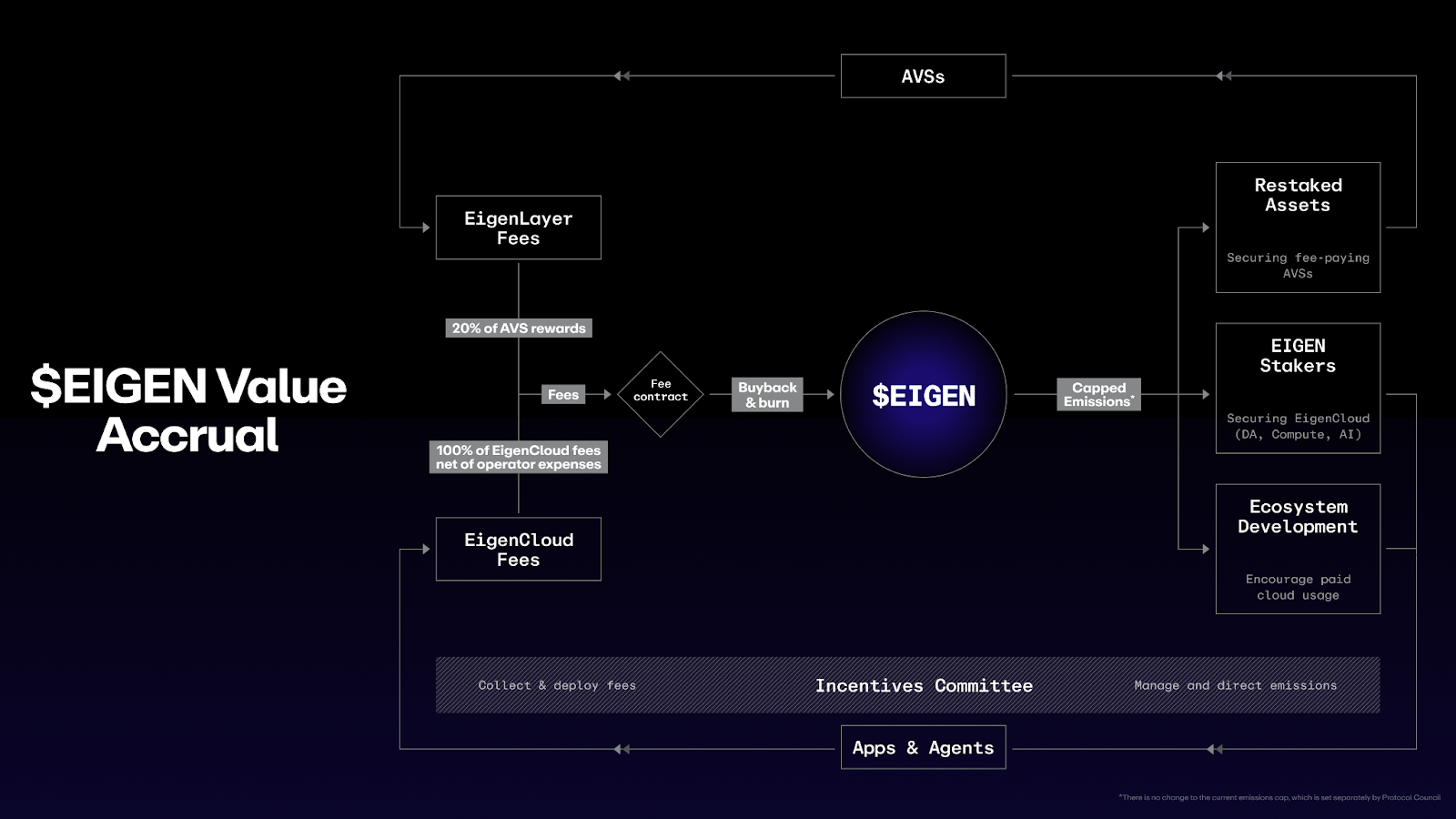
What’s changing: The Incentives Committee will introduce mechanisms to collect and use EigenLayer and EigenCloud fees to benefit EIGEN token holders. On stake that is subsidized by EIGEN incentives, the Committee will propose a 20% fee on AVS rewards. These fees would be directed to a fee contract that can be used for buybacks. Moving forward, only fee-paying AVSs will be eligible for Staker and ecosystem incentives. Similarly, as revenue grows on EigenAI, EigenCompute and EigenDA, 100% of cloud fees after operator expenses will be directed to the same fee contract for buybacks.
What it means: Every unit of EigenCloud usage and a fraction of AVS rewards will accrue value directly to the token. The Incentive Committee will also have the ability to direct accumulated fees in the fee contract towards buybacks that reduce circulating supply and create new deflationary pressure on EIGEN as the ecosystem scales.
2. A mandate to manage inflation and direct fee revenue.
What's changing: The Incentives Committee will be given an initial mandate to reduce rewards for idle stake, direct EIGEN token emissions to fee-paying AVSs and design incentives for AVSs to pay rewards against that stake. The Incentives Committee will also explore changes to EIGEN staking rewards and other levers to encourage paid consumption of EigenCloud services.
What it means: In the near term, rewards will shift toward productive stake, such as slashable and redistributable stake, while baseline rewards to idle stake may decline over time as the Incentives Committee redirects emissions.
3. New flexibility to direct emissions towards fee generating activities and growth
What's changing: Currently, any modification to how EIGEN emissions are allocated to different constituents, requires an ELIP. Contract modifications that take time to code, audit, test, and deploy. The Incentives Committee will be able to quickly modify the allocation of EIGEN emissions without requiring lengthy contract upgrades. Any change to the maximum total amount of emissions, however, remains subject to Protocol Committee governance.
What it means: The Incentives Committee can respond to new opportunities in weeks, not months, directing rewards where they create the most value.
Why the Change?
Programmatic Incentives V1 and V2 served their purpose: they bootstrapped restaked capital and provided predictable baseline rewards to Stakers and Operators, but have not achieved the incentive alignment between builders, Operators, Stakers, and the protocol necessary for continued growth. A one-size-fits-all approach limits optionality and speed for iterating on incentives as the ecosystem evolves. With the implementation of ELIP-12, the Protocol Committee and Incentives Committee will be able to promote the long-term viability and growth of the protocol by setting emissions policy to:
- Direct rewards to real activity. EigenLayer’s maturing AVS ecosystem—with teams like ETHGas, Infura's DIN, LayerZero, and CAP hitting mainnet with slashable or redistributable stake enabled—needs capital backing to scale. Rewards should flow to services attracting productive stake and emissions may be reduced to idle capital that does not secure AVSs.
- Reduce overall emissions. Work together to ensure emissions are set at the right level.
- Focus on fee generating activity. Concentrate incentives on a smaller number of high-quality participants that drive network security and fee generating usage, rather than spreading rewards broadly to idle stake.
- Enable thoughtful discretion. Adapt quickly and avoid blanket policies that can be gamed or exploited.
This approach aligns incentives across the ecosystem: Stakers and Operators backing active services earn more, AVSs get the capital they need, and EIGEN benefits from improved tokenomics.
What to Expect
The Incentives Committee transition happens in two phases:
- The Protocol Council ratifies the Incentives Committee. Recently, the Incentives Committee (ELIP-12) proposal was submitted for review by the EigenLayer community. If the Protocol Committee ratifies the proposal, they'll implement the onchain changes needed to create the Incentives Committee and authorize it to allocate emissions.
- The Incentives Committees’ first proposals go live. After implementation, the Incentives Committee will be empowered to publish its priorities and recommended changes consistent with its mandate from the Protocol Council. As presently proposed, the Incentives Committee may focus its attention on:
- AVSs to attract slashable and redistributable stake and incentive AVSs to pay rewards against that stake (unique staking incentives and discretionary rewards matching);
- New incentive programs that can experiment with distribution criteria that may include subjective elements or elements otherwise impossible to encode onchain; and
- New incentive programs to encourage and bootstrap apps building, deploying, and scaling on EigenCloud and its ecosystem of AVSs and their Operators and Stakers.
These changes are the first of a series of steps towards improving EIGEN tokenomics. By directing rewards to active AVSs and productive stake, the Incentives Committee will be able to stimulate monetizable growth across EigenCloud, accruing value to the protocol and the EIGEN token. You can follow along with the Incentives Committee’s future changes or proposals on their Forum page.
How to Position Your Stake for Rewards
EigenLayer's AVS ecosystem has accelerated significantly, with three major mainnet launches in November demonstrating mainnet adoption of slashable and redistributable stake:
- Infura’s DIN went live on mainnet on EigenLayer, bringing a new layer of economic security and decentralization to Web3's critical RPC infrastructure. This launch highlights the platform's ability to secure fundamental Web3 services.
- LayerZero and EigenCloud launched EigenZero, marking the first tangible implementation of the cutting-edge CryptoEconomic Decentralized Verifier Network (DVN) Framework. EigenZero demonstrates the composability and flexibility of EigenLayer's design for cross-chain interoperability.
- CAP launched on mainnet, backed by publicly traded Flow Traders, a significant moment that bridges the worlds of traditional finance (TradFi) and decentralized finance (DeFi). CAP's launch, in collaboration with YieldNest, showcases how EigenLayer can onboard institutional-grade capital and sophisticated market participants to enhance onchain security.
As proposed, the Incentives Committee will be able to direct EIGEN rewards to live AVSs based on criteria they’ll publish, including to services that utilize slashable and redistributable stake on mainnet. Stay tuned for further updates on the progress of ELIP-12 and future Incentives Committee communications on rewards allocation to stay informed on how to position your stake to benefit from network growth while contributing to protocol security and fee generation.
→ If you would like to allocate your stake to active AVSs, go to app.eigenlayer.xyz/avs.
Resources
We know this announcement may impact some users' plans on how they allocate stake, build, and which AVSs they want to run. We’ve written unique guidebooks for each user group to reference.
What to expect if you’re a Staker
What to expect if you’re an Operator
What to expect if you’re an AVS Builder
Get Started Building
We think this is a unique opportunity for builders to build their service on EigenLayer. This new era for incentives will benefit real builders who want to gain stake to power their applications.
Are you interested in building services that require stake to power your application? EigenLayer's restaking features provide the cryptoeconomic enforcement layer you need.
- For AVS Developers: → docs.eigencloud.xyz/eigenlayer/concepts/eigenlayer-overview
- For Operators: → docs.eigencloud.xyz/eigenlayer/operators/concepts/operator-introduction
- For Restakers: → app.eigenlayer.xyz